Posts

Showing posts with the label tips

Single Trait Characters: When They're Useful and How To Use Them

Image
Whether you recognize the term or not, we all know the trope of the single-trait character. These guys show up at least once in every book, movie, and TV show, and they're useful because they fill up space and they're easily identified. A single-trait character is someone who appears in a story and is recognized/identified by (you guessed it) a single, solitary trait. The tall one. The loud one. The one who loves soccer. Characters such as these are useful as background characters, and they're easy to tell apart because they each only have one characteristic to be remembered by. Aside from Jamie, none of the kids in Rise of the Guardians strictly have  any deep characteristics, but since we were already dealing with such a large cast of  characters,  none of the kids strictly *needed* a complex personality . Now, before we go into how to use a single-trait character, let's first talk about how not to use a single-trait character. As always, this isn't necessarily wr...
Some random writing tips

Image
Put your phone far enough away that you can't reach it because being too lazy to get up > desire to reach phone = you'll be forced to write Listen to Hans Zimmer soundtracks, they're literally written to keep you engaged and they help you focus When you're line editing, put things that will take more thought [in brackets] so that later you can just search the documents for the brackets and find all those things at once. If you're stuck on one thing in the document, go to a different thing and work on that. Your mind will be clearer to deal with the problem when you come back. If you're struggling to begin something, even an outline(cuz I do a lot), title it like this: Outline 1, But This is the Sucky Version . If you give yourself permission to suck or outline it in a way where if it's the worst it doesn't matter, it makes it so much easier to begin. Don't open the word document or look at the page until you already know how you're going to be...

some things I've learned about descriptions from googling 'how to describe things'

Image
Something I'm learning from this current draft of Robbing Centaurs and Other Bad Ideas is that I'm really bad at descriptions. I underdescribe, I overdescribe, I put in confusing visuals, my sentences are awkward... I'm just really bad at descriptions. And now that I think about it, descriptions are something that have always been really frustrating for me to try to write. I can picture all these cool places and ideas, but I have no idea how to make the reader see and feel them the way I do. It's probably one of the most frustrating parts of writing for me. Therefore, after seeing all the notes from my sweet editor on descriptions that could be improved, I did a hearty bit of googling on how to write descriptions. This is what I found.  Give the description a flow. Your MC spots another character in the room. What do they notice first, and why? What do they notice after that? Don't just say 'their hair was black and their eyes were blue', that doesn't wo...

How to Write Scary (part 2!)

Image
  I wrote a post in July of 2019 on how to write scary stuff . And in the name of October and all things scary, here's another one. I thought of some new stuff recently and went 'hmm, why not do a part 2 to something everyone's already forgotten?' So here it is! How To Write Scary Pay attention to the pacing of the scene and the way you're pacing your prose.  Pacing is always important, but in something like horror, it's crucial. Think of how it feels when a scary part comes along in a movie. Sometimes the characters pause briefly to catch their breath, and then all of a sudden there's something in front of them! The pace goes from a trickle to a roar very fast. I feel like I'm describing what I mean badly here, but hopefully you get the point. Sensory details are your friend What's the temperature in the room? What's the texture of the furniture your character is sitting on? Is there a ringing in their ears? Butterflies in their stomach? It'...

6 Ways To Name Chapters If You're Bad At It

Image
I'm bad at naming chapters. The worst, actually. I used to write out the whole chapter without naming it, then go back through, agonizing over what to use as the title name. All the titles I could think of were either over-the-top or just lame. It was a pain for so long before I finally started paying attention to the chapter titles in other books and realized that a traditional chapter title was not required. I really have no idea if this is a common issue with other writers, for all I know everyone else can name chapters with less effort than it takes to blink. But if it's hard for you like it's hard for me, keep reading. This one's for you. ;) Idea #1: Don't name them! Just use numbers. You don't always need a title, and frankly, readers put very little pressure on you to title them in the first place. You can skip the name and just give the chapter a number. And there are many ways to number, too! You can use just plain numbers(20,21,22) or write them out(Tw...

Have you rewarded your writing recently?

Image
It's simple: effort without reward = no fun. Have you stopped to reward yourself for writing recently? Have you ever  stopped to reward yourself for writing? Have you finished a tough scene, or reached a word goal, or done something hard, and then rewarded yourself for it? You should. As a writer, you are your own boss, and you need to be a fair one. Effort merits reward. Finishing on time deserves a pat on the back. A reward can be anything. It can be a quick YouTube video after finishing your writing session for the day. It can be a Saturday off if you consistently write every day, Monday through Friday. It can be a face mask at the end of the day because you want one. Even 20 minutes of free reading time in the evening will suffice. But make sure you reward yourself. Be a fair boss. Your brain is working hard here. And I'm talking to myself here as well as you. I'm terrible at telling myself I did well. I'm terrible at making sure I get rewarded for my hard work. I...

My Dialogue Pet Peeves

Image
Photo by  Kaboompics .com  from  Pexels I'm so picky about dialogue. Probably too picky. But it's people! Talking! And they gotta sound real!! I know everyone tries so hard to make dialogue sound good, but there are just some things I see over and over that pull me out of the narrative and make me go 'well yuck'. Bear in mind that these are opinions . They're subjective, you don't have to listen to me. I'm just talking about it because I want to. So let's go! 'he presented' 'she queried' 'he cautioned'  Just seriously, don't use a distracting, complicated word when 'said' will work just fine. Of course, there is absolutely nothing wrong with plenty of other dialogue tags, but some of them are just useless. I can tell he's cautioning because he's saying "be careful!" Honestly when I see the word 'queried' being used instead of 'said' it just sets my teeth on edge. And on another note, s...

How to Draw Character Art for the Artistically Challenged

Image
Not everyone can be good at drawing. I get that. For some of you, you can try to draw something and you end up with a cucumber? In a hat?? Not everyone has super artsy genes. SO HERE I AM AS YOUR ART FAIRY GODMOTHER TO ASSIST YOU. TODAY YOU SHALL DRAW CHARACTER ART. I'm going to give you several different techniques, from 'super beginner' to 'just ok at art' and everywhere in between, and you shall find the magic touch that will make you able to make character art. So have a seat, and I'll tell you what you can do! Level 1: Tracing over a picture If you are the most beginner-est of all beginners, fret not, I got u. Even if you feel that you don't have a drop of artistic talent, trust me, you can trace. Print up a picture that resembles the character you want to draw and make sure you print it big enough to be around the size you want your drawing. Place another piece of paper over the printed picture and slap both of them against a light surface so you can s...

The Bag Test- A Fun Way To Flesh Out a Character

Image
Those of you who have read Gail Carson Levin's book 'Writing Magic' will remember Gail's character questionnaire, and specifically, two unconventional questions on it. 1) Describe his/her room 2) Items in his/her pockets, backpack, or purse Most questionnaires don't have questions like these, and that's what made them stand out to me as a young writer. Why would one need to know either one of these things to understand the character, you may ask? Because they help us figure out what kind of person your character is, all based on what things they keep around them. Why it's important For example, the state of your character's room says something about their personality. If their room is messy, that tells us that their state of mind might be messy, or that they're currently too busy or distracted to clean, or that they're bad with responsibilities such as cleaning. And we could take it a step further from there. The room is messy, bu...

The Invasion of the Sanctuary- A Trope and Why It's Great

Image
I can guarantee you've seen this trope before. When the Witch followed Digory back to London. When the monsters made it into the TARDIS. When Hobbiton burned to the ground. When the hero made it home only to discover the supervillain was waiting for them there. Anytime the villain manages to force their way into a place that both the protagonist and the reader thought was safe and untouchable, that's the Invasion of the Sanctuary. The purpose of this trope is to shatter the protagonist's illusion of safety and to throw them off balance. It's great for giving the readers and 'all is lost' moment. After all, when the place we thought was so beautiful and immortal is invaded and perhaps is destroyed, how much worse can it really get? Why it works This technique is almost not used enough to even call it a trope, but trope was the best word I could think of to describe it, so trope it shall be. The Invasion of the Sanctuary is a wonderful oppo...

All the Character Outlining 101 Posts and a Free PDF!!

Image
If you wanted to see all the Outlining 101 posts in one place, look no further! This post is the culmination of the series, and this is the one with the PDF in it, if you happened to be looking for that one in my sea of posts. Firstly, here are the links to the individual posts, in order that I posted them: Main Characters/Overall Antagonists Secondary Characters The Mentor And now, as promised, I am including a PDF of printable worksheets for all your characters! Rather than just copying all these questions into a notebook, you can print up the sheet and just fill it out on the lines. You're welcome, and enjoy! Click the image to be taken straight to the PDF, where you can download your own copy. Btw, I would love to see if this PDF is being used. If you're using it, let me know in a comment, or in a tag on Instagram or Twitter! My handles are below. I'd love to interact with you! Twitter: @ScribbldFiction Instagram: @scribbledfiction

Character Outlining 101- How I Outline the Mentor

Image
The mentor can be a complicated character to write. Finding a mentor for your protagonist can be a complicated business in the first place, and then on top of all that they have to be a fully fleshed-out character while being somehow wiser than the protagonist is. But fret not. I have just the tools to help you build a good one. Let's go! I don't know about you, but my favorite mentors are the ones that are unexpected. The little red dragon who is determined to help Mulan succeed and prove his own worth at any cost. The guy in the mountains who helped Batman reach his fullest potential before (*SPOILERS*) ultimately becoming the villain. The fallen demigod set on getting back his magic hook and redeeming his standing with the gods. Those mentors. The unexpected, imperfect, beautifully flawed mentors. Unfortunately, I have no surefire tips for helping you identify who your mentor other than this: Who helps your protagonist move forward and who does your protagoni...

Character Outlining 101: How I Outline Villains

Image
All right, it's time for another session of character outlining. This time around, it's the villain! What's your villain like? You don't know! So that's what we're here to work out. If you haven't already read part 1 of this series, Outlining Characters 101: How I Outline Characters (A Simple But Effective Format), click here to read it before you continue. Ultimately, writing villains is the same as writing any other character. After all, they're people too, with allergies and preferences and blood types. But to outline a villain, there are a few key things to include that you wouldn't include in most other character outlines. So let's begin! Villain questionnaires start the same as any other: Name Age Appearance Likes Dislikes And it's here that the outline starts to change. The questions above are the basics, stuff that I would consider necessary knowledge for almost any character.  So at this point one will probably...

Outlining Characters 101: How I Outline Characters (A Simple But Effective Format)

Image
Scary question: How do you outline a good character? Don't worry, it's not the format's fault if your character isn't so great. A bad format might prevent you from thinking of a few details that might have helped you flesh out a character a little further, but it's not the format's fault if your character wasn't interesting. I think the most important part of creating characters is figuring out what kind of character questionnaire works the best for you. Over time, slowly crafting my own has been so fun. It's a little fuzzy around the edges, but it's mine, and I want to share it. The best thing about this character questionnaire is that it's not that long. I've worked with so many character questionnaires before that had 50, even 100 questions. That's too many. I felt like the longer I worked at them, the less clear the character felt in my head. That's why I think simple but deep ones work so much better.  ...

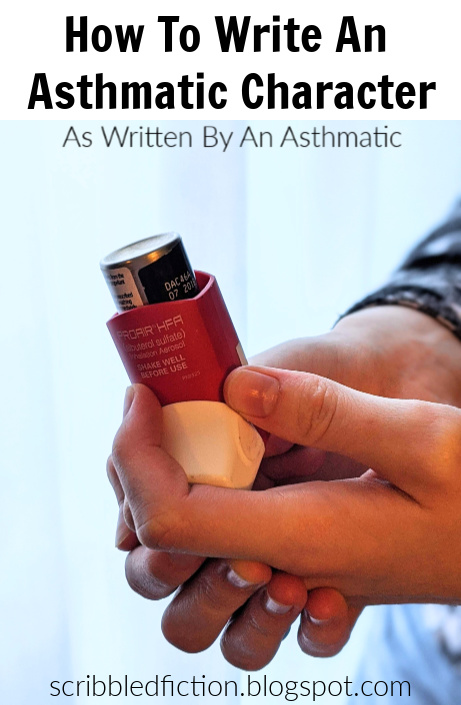
How To Write An Asthmatic Character(As Written By An Asthmatic)

Image
Hi, I'm Bethany, I'm an asthmatic, and I'm here to    e d u c a t e  y o u So the inaccurate way asthmatic people are portrayed in stories really bugs me. They shouldn't be taking their inhalers for nothing, and certainly not every thirty seconds. I would dearly love to see a realistic asthmatic character, one that I can identify with and laugh with. I would love that. So. Your education on asthma begins now. What is asthma? Good question, I'm glad you asked. From Mayo Clinic: Asthma is a condition in which your airways narrow and swell and produce extra mucus. This can make breathing difficult and trigger coughing, wheezing and shortness of breath. So basically, my airways have less room to breathe in than yours, so I'm constantly at risk of having them suddenly close up or fill with mucus, therefore causing: an asthma attack. An asthma attack happens when either my tubes produce too much mucus(filling the airways) or when my tubes cons...

Optimists vs. Pessimists- What You Take For Granted and How It Affects Your Thinking

Image
I've still been thinking about the whole optimists and pessimists thing since writing  Optimists vs. Pessimists  a few months ago. There's a lot of ground I didn't cover. And bear with me here. I'm not pretending to know everything there is to know about this topic. I've never claimed to know everything there is to know about any topic. Heck, I've never even claimed to know much about any topic. A lot of what I've learned in my life has been gleaned through careful observation and inner analysis. This topic is no different. With that out of the way, now I can talk. I've talked about what optimists and pessimists are at the core, but I think I left out something very important. There was an interesting aspect of the topic that I hadn't thought of before. And that is  what we take for granted . What you think about, or rather what you don't bother to think about affects your thinking. The things you consider to always be constant a...

Writing Realistic- Big Families

Image
I honestly don't know what's with the way people write families anymore. I've known a lot of big families over the course of my life, and none of them look like the family from Yours, Mine, and Ours , with fighting every minute, absurd schedules for bathroom time, the house is near burning down at least twice a day. Just... no. So let's do a little list of true and false so that all of us writers out there can get this right. False: Everyone is constantly fighting because there's limited space. Yeah, I'll admit, with eight of us total in the house, there's a little less elbow room than there could be. But if you've grown up like that (like the kids in every since big family movie have) you don't really notice it. You're more likely to notice the extra space other people have. The family in  Yours, Mine, and Ours had a massive house anyway, so I don't know why they were all bunched together in every scene. Realistically, if they re...